
Back to the list | Abstract | Contents
 Abstract
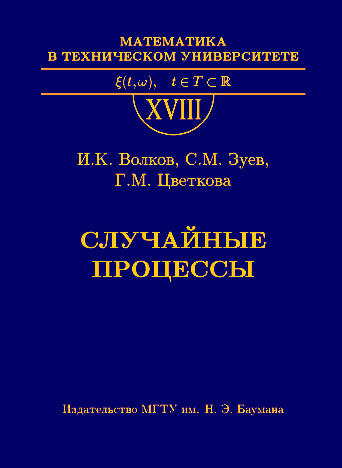
The eighteenth volume of the 20-volume series “Mathematics at a Technical University” introduces the basic concepts of the theory of random processes and some of its many applications. The authors intend it as a bridge between rigorous mathematical research on the one hand and practical problems on the other, helping the reader master applied methods of random process theory.
The textbook follows the lecture course the authors give at Bauman MSTU.
For students of technical universities; also useful for lecturers and postgraduates.
Contents
| Preface | ||
| Main notation | ||
| Introduction | ||
| 1. | Basic concepts and definitions | |
| 1.1. | Random function, random process and random sequence | |
| 1.2. | Mean and covariance function of a random process | |
| Questions and problems | ||
| 2. | Some types of random processes | |
| 2.1. | Stationary random processes | |
| 2.2. | Gaussian processes | |
| 2.3. | Processes with independent increments | |
| 2.4. | The Wiener process | |
| 2.5. | Markov processes | |
| 2.6. | The Poisson process | |
| Questions and problems | ||
| 3. | Elements of stochastic analysis | |
| 3.1. | Mean-square convergence | |
| 3.2. | Continuity of a random process | |
| 3.3. | Differentiability of a random process | |
| 3.4. | Integrability of a random process | |
| 3.5. | A linear operator acting on a random process | |
| 3.6. | Ergodic random processes | |
| Questions and problems | ||
| 4. | Spectral theory of stationary random processes | |
| 4.1. | Stationary processes with a discrete spectrum | |
| 4.2. | Stationary processes with a continuous spectrum | |
| 4.3. | White noise | |
| 4.4. | Transformation of a stationary random process passing through a linear dynamic system | |
| Questions and problems | ||
| 5. | Markov processes with discrete states and Markov chains | |
| 5.1. | Basic concepts | |
| 5.2. | Tsepi Markova | |
| 5.3. | Kolmogorov equations for state probabilities | |
| 5.4. | Birth–death process and cyclic process | |
| Questions and problems | ||
| 6. | Elements of queueing theory | |
| 6.1. | Queueing processes (basic concepts) | |
| 6.2. | The simplest flow | |
| 6.3. | Waiting time and service time | |
| 6.4. | Principles of building Markov queueing models | |
| 6.5. | Queueing systems with waiting | |
| 6.6. | Steady-state operation of a queueing system (basic concepts and relations) | |
| 6.7. | Steady-state operation of some queueing system variants | |
| Questions and problems | ||
| 7. | Stochastic state models | |
| 7.1. | Random disturbances in a dynamic system | |
| 7.2. | Linear stochastic differential equations | |
| 7.3. | Stochastic integrals and differentials | |
| Questions and problems | ||
| 8. | Markov processes with continuous states | |
| 8.1. | General properties of Markov processes | |
| 8.2. | Uravneniya Kolmogorova | |
| 8.3. | Stochastic state models and Kolmogorov equations | |
| 8.4. | Formulating problems for the conditional probability density | |
| 8.5. | Three typical problems of the theory of continuous-state Markov processes | |
| Questions and problems | ||
| 9. | Elements of statistics of random processes | |
| 9.1. | Observation data | |
| 9.2. | Statistical moments of a random process | |
| 9.3. | Formulating the parameter estimation problem | |
| 9.4. | Efficient estimates. The Rao–Cramér inequality | |
| 9.5. | Uniqueness of the solution of the parameter estimation problem | |
| 9.6. | Maximum likelihood method | |
| 9.7. | Least squares method | |
| Questions and problems | ||
| 10. Estimating parameters of stochastic state models | ||
| 10.1. | The stochastic state model revisited | |
| 10.2. | Uniqueness of parametric identification of a stochastic state model | |
| 10.3. | Choosing observed variables | |
| 10.4. | Specifics of estimation with measurement errors | |
| 10.5. | Filtr Kalmana | |
| 10.6. | Parameter estimation with measurement errors | |
| Questions and problems | ||
| Appendix 1. Basic concepts of probability theory | ||
| Appendix 2. The matrix exponential | ||
| Recommended reading | ||
| Subject index | ||