
Back to the list | Abstract | Contents
 Abstract
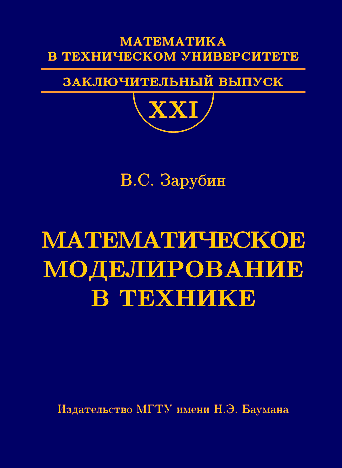
This supplementary twenty-first volume completes the textbook series “Mathematics at a Technical University”. It is devoted to applying mathematics to practical problems in various fields of engineering and includes a subject index to all 20 volumes of the series.
The textbook follows the course “Fundamentals of Mathematical Modelling” the author gives at Bauman MSTU.
For students of technical universities; also useful for lecturers, postgraduates and engineers.
Contents
| To the reader | ||
| Preface | ||
| Main notation | ||
| 1. | The role of mathematical modelling in engineering | |
| 1.1. | Modelling and technical progress | |
| 1.2. | Main stages of mathematical modelling | |
| 1.3. | Mathematical models in engineering disciplines | |
| Questions and problems | ||
| 2. | The mathematical model | |
| 2.1. | The notion of a mathematical model | |
| 2.2. | Structure of a mathematical model | |
| 2.3. | Properties of mathematical models | |
| 2.4. | Structural and functional models | |
| 2.5. | Theoretical and empirical models | |
| 2.6. | Features of functional models | |
| 2.7. | Hierarchy of mathematical models and forms of their representation | |
| A.2.1. | Introduction to dimensional analysis | |
| A.2.2. | Representing a mathematical model in dimensionless form | |
| Questions and problems | ||
| 3. | Mathematical models of the simplest standard elements | |
| 3.1. | Electrical two-terminal elements | |
| 3.2. | The simplest elements of mechanical systems | |
| 3.3. | Some elements of thermal systems | |
| 3.4. | Models of hydraulic system elements | |
| A.3.1. | Features of pneumatic systems | |
| A.3.2. | Laminar flow of a viscous fluid in a pipeline | |
| A.3.3. | On the adequacy of mathematical models of standard elements | |
| Questions and problems | ||
| 4. | Mathematical models of systems of standard elements | |
| 4.1. | Dual electrical circuits | |
| 4.2. | Duality of the electromechanical analogy | |
| 4.3. | Mathematical model of a linear oscillator | |
| 4.4. | Examples of mathematical models of thermal and hydraulic systems | |
| 4.5. | Formalizing the construction of a mathematical model of a complex system | |
| A.4.1. | Refining the mathematical model of a linear oscillator | |
| A.4.2. | On building mathematical models of mechanical systems | |
| Questions and problems | ||
| 5. | Nonlinear macro-level mathematical models | |
| 5.1. | Sources of nonlinearity | |
| 5.2. | Static and steady-state models | |
| 5.3. | Some unsteady models | |
| 5.4. | The simplest dynamic models | |
| 5.5. | Equilibrium positions of a conservative system | |
| 5.6. | Phase portrait of a conservative system | |
| 5.7. | Mathematical models of some dissipative systems | |
| 5.8. | The notion of self-oscillating systems | |
| A.5.1. | Approximate methods for analysing dynamic models | |
| Questions and problems | ||
| 6. | Micro-level mathematical models | |
| 6.1. | Micro-level models of electrical two-terminal elements | |
| 6.2. | One-dimensional models of steady heat conduction | |
| 6.3. | Mathematical models of unsteady heat conduction | |
| 6.4. | One-dimensional models of hydraulic systems | |
| A.6.1. | Mathematical model of induction heating | |
| A.6.2. | An example of using micro-level models in optimal design | |
| Questions and problems | ||
| 7. | Algorithmization of mathematical models | |
| 7.1. | Ways of converting mathematical models to algorithmic form | |
| 7.2. | Computational operations of linear algebra | |
| 7.3. | Vector-pipeline computation algorithms | |
| 7.4. | On parallelizing matrix computations | |
| 7.5. | Operations with sparse matrices | |
| Questions and problems | ||
| Recommended reading | ||
| Subject index to volume XXI | ||
| Subject index to the 20-volume textbook series | ||
| Afterword by the series editors | ||