
Back to the list | Abstract | Contents
 Abstract
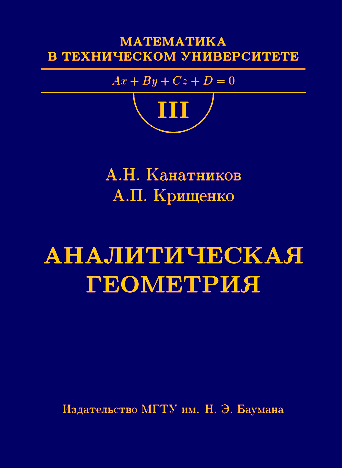
The third volume of the 20-volume textbook series “Mathematics at a Technical University” introduces the basic concepts of vector algebra and its applications, matrices and determinants, systems of linear algebraic equations, and second-order curves and surfaces, to the extent needed at the start of a technical university course.
The textbook follows the lecture course the author gives at Bauman MSTU.
For students of technical universities; also useful for lecturers and postgraduates.
Contents
| Preface | ||
| Main notation | ||
| 1. | Linear operations on vectors | |
| 1.1. | Vector and scalar quantities | |
| 1.2. | Types of vectors and their relative position | |
| 1.3. | Linear operations and their properties | |
| 1.4. | Orthogonal projection | |
| 1.5. | Linear dependence and independence of vectors | |
| 1.6. | Basis | |
| 1.7. | Computing in coordinates | |
| Questions and problems | ||
| 2. | Products of vectors | |
| 2.1. | Second- and third-order determinants | |
| 2.2. | Scalar product | |
| 2.3. | Vector product | |
| 2.4. | Triple product | |
| 2.5. | Applications of vector products | |
| 2.6. | Vector triple product | |
| Questions and problems | ||
| 3. | Coordinate systems | |
| 3.1. | Cartesian coordinates | |
| 3.2. | Transformation of rectangular coordinates | |
| 3.3. | Simplest problems of analytic geometry | |
| 3.4. | Computing areas and volumes | |
| 3.5. | Curves and surfaces | |
| 3.6. | Polar coordinates | |
| 3.7. | Cylindrical and spherical coordinates | |
| Questions and problems | ||
| 4. | The line in the plane | |
| 4.1. | First-order algebraic curves | |
| 4.2. | Special forms of the equation of a line | |
| 4.3. | Relative position of two lines | |
| 4.4. | Distance from a point to a line | |
| Questions and problems | ||
| 5. | Lines and planes in space | |
| 5.1. | First-order algebraic surfaces | |
| 5.2. | Special forms of the equation of a plane | |
| 5.3. | Equations of a line in space | |
| 5.4. | Relative position of lines and planes | |
| 5.5. | Distance to a plane and to a line | |
| 5.6. | Pencils and sheaves | |
| Questions and problems | ||
| 6. | Matrices and operations on them | |
| 6.1. | Types of matrices | |
| 6.2. | Linear operations on matrices | |
| 6.3. | Matrix transposition | |
| 6.4. | Matrix multiplication | |
| 6.5. | Block matrices | |
| 6.6. | Direct sum of matrices | |
| 6.7. | Linear dependence of rows and columns | |
| 6.8. | Elementary matrix transformations | |
| Questions and problems | ||
| 7. | Determinants | |
| 7.1. | Determinants of order n | |
| 7.2. | Properties of determinants | |
| 7.3. | Methods of computing determinants | |
| Questions and problems | ||
| 8. | Inverse matrix and matrix rank | |
| 8.1. | The inverse matrix and its properties | |
| 8.2. | Computing the inverse matrix | |
| 8.3. | Solving matrix equations | |
| 8.4. | Matrix rank | |
| 8.5. | The basis minor theorem | |
| 8.6. | Computing matrix rank | |
| Questions and problems | ||
| 9. | Systems of linear algebraic equations | |
| 9.1. | Basic definitions | |
| 9.2. | Forms of writing linear systems | |
| 9.3. | Consistency criterion | |
| 9.4. | Formuly Kramera | |
| 9.5. | Homogeneous systems | |
| 9.6. | Inhomogeneous systems | |
| 9.7. | How to solve linear systems? | |
| 9.8. | Linear systems with complex coefficients | |
| Questions and problems | ||
| 10. Numerical methods for linear systems | ||
| 10.1. | Computational issues | |
| 10.2. | Direct and iterative methods for linear systems | |
| 10.3. | Metod Gaussa | |
| 10.4. | Features of Gaussian elimination | |
| 10.5. | The tridiagonal matrix algorithm | |
| 10.6. | Multiplicative matrix decompositions | |
| Questions and problems | ||
| 11. Second-order curves | ||
| 11.1. | Ellipse | |
| 11.2. | Hyperbola | |
| 11.3. | Parabola | |
| 11.4. | Incomplete equations of a second-order curve | |
| 11.5. | Polar equations | |
| Questions and problems | ||
| 12. Second-order surfaces | ||
| 12.1. | Surfaces of revolution and compression | |
| 12.2. | Ellipsoids | |
| 12.3. | Hyperboloids | |
| 12.4. | Elliptic paraboloids | |
| 12.5. | Cones | |
| 12.6. | Cylindrical surfaces | |
| 12.7. | Method of sections | |
| 12.8. | Incomplete equations of a second-order surface | |
| 12.9. | Conical and ruled surfaces | |
| 12.10. | Conic sections | |
| Questions and problems | ||
| Recommended reading | ||
| Subject index | ||