
Dimitrienko Yu.I., Zakharov A.A.
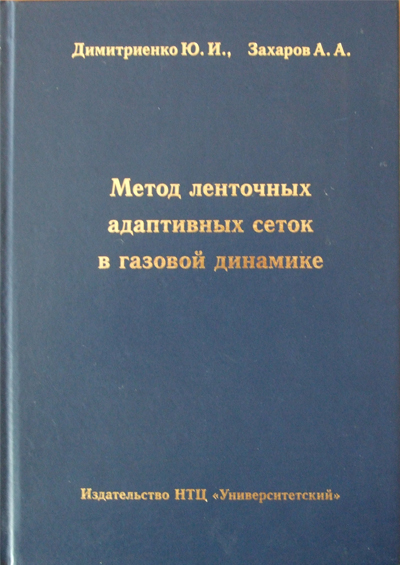
The textbook sets out the theoretical foundations of the band adaptive mesh method for numerical solution of gas dynamics problems. It covers the general principles of building geometrically adaptive regular difference meshes and elements of computer geometry for generating two- and three-dimensional domains, methods of constructing difference schemes on adaptive meshes, and examples of using the method to model gas dynamic processes in solid rocket motor nozzles and supersonic air intake ducts. It also shows the specifics of problems with chemical reactions, viscosity and heat conduction of gas flows.
For senior students and postgraduates in physics, mathematics and mechanical engineering.
Other works by Yu. I. Dimitrienko
CONTENTS
Preface
Introduction
Chapter 1. The band adaptive mesh method for two-dimensional domains
1.1. Building an adaptive mesh for a curvilinear quadrilateral
1.2. Spline interpolation of the boundaries of curvilinear domains
1.3. Generating an arbitrary curvilinear domain in the plane
1.4. Generating an adaptive mesh for an arbitrary curvilinear domain
1.5. Computing derivatives in an adaptive coordinate system
1.6. Finite difference approximation of derivatives on adaptive meshes
1.7. Generating an adaptive mesh for a curvilinear cube
1.8. Finite difference approximation of derivatives for 3D domains
Chapter 2. Software for generating adaptive meshes
2.1. Introduction
2.2. User interface
2.3. The mesh window
2.4. The project window
2.5. The plot window
2.6. Exporting and importing adaptive meshes
Chapter 3. Difference schemes for the ideal gas dynamics equations in the band adaptive mesh method
3.1. The ideal gas dynamics equations
3.2. Boundary and initial conditions
3.3. Reducing the gas dynamics equations to divergence form in adaptive coordinates
3.4. The gas dynamics equations in non-divergence form in adaptive coordinates
3.5. Decoding the unknown functions
3.6. Axisymmetric formulation of the gas dynamics problem
3.7. Boundary and initial conditions in adaptive coordinates
3.8. Difference schemes for the gas dynamics equations in the method
3.9. Approximation and stability of MacCormack-type schemes
3.10. Numerical approximation of boundary conditions of the axisymmetric problem in adaptive coordinates
3.11. Second-order numerical approximation of boundary conditions
Chapter 4. Modelling two-dimensional gas dynamic processes in solid rocket motor combustion chambers
4.1. Typical solid rocket motor designs
4.2. A model of gas dynamic processes in a solid rocket motor
4.3. Results of numerical modelling
4.4. Results of numerical modelling for a combustion chamber with a submerged nozzle
Chapter 5. The band adaptive mesh method for chemically reacting ideal gas dynamics
5.1. Equations of chemically reacting ideal gas dynamics
5.2. Boundary and initial conditions
5.3. Relations for the mass production rate of chemical components
5.4. A model of the linear rate of physicochemical transformations
5.5. The axisymmetric problem
5.6. Axisymmetric equations in adaptive coordinates
5.7. Applying the method to the axisymmetric problem
5.8. Results of modelling combustion product dynamics in a solid rocket motor with chemical reactions
Chapter 6. Modelling gas dynamic processes in a solid rocket motor with a viscous heat-conducting gas model
6.1. Equations of viscous heat-conducting gas dynamics
6.2. Boundary and initial conditions
6.3. Viscous gas equations in adaptive coordinates
6.4. Dimensionless form of the equations
6.5. Axisymmetric equations in cylindrical and adaptive coordinates (non-divergence form)
6.6. Axisymmetric equations in adaptive coordinates (divergence form)
6.7. The method for the viscous gas equations
6.8. Results of modelling ignition in a solid rocket motor combustion chamber
Chapter 7. Modelling gas dynamic processes in supersonic air intakes
7.1. Scramjet air intakes
7.2. A mathematical model of gas dynamic processes in a scramjet air intake
7.3. Results of numerical solution of inviscid gas deceleration in the intake
7.4. Mathematical formulation of 3D modelling of gas dynamic processes in a scramjet
7.5. A MacCormack-type scheme for 3D gas dynamics equations
7.6. Results of modelling flows in scramjet intakes
References