
Back to the list | Abstract | Contents
 Abstract
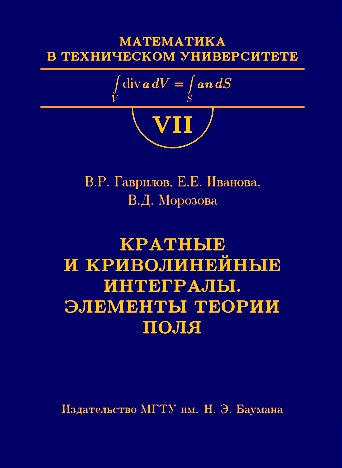
The seventh volume of the textbook series “Mathematics at a Technical University” introduces multiple, line and surface integrals and methods for computing them, with attention to their applications and examples from physics, mechanics and engineering. The final chapters present elements of field theory and vector analysis.
The textbook follows the lecture course the authors give at Bauman MSTU.
For students of technical universities; also useful for lecturers, postgraduates and engineers.
Contents
| Preface | ||
| Main notation | ||
| 1. | Double integrals | |
| 1.1. | Problems leading to the double integral | |
| 1.2. | Definition of the double integral | |
| 1.3. | Existence conditions for the double integral | |
| 1.4. | Classes of integrable functions | |
| 1.5. | Properties of the double integral | |
| 1.6. | Mean value theorems for the double integral | |
| 1.7. | Computing the double integral | |
| 1.8. | Curvilinear coordinates in the plane | |
| 1.9. | Change of variables in the double integral | |
| 1.10. | Surface area | |
| 1.11. | Improper double integrals | |
| Questions and problems | ||
| 2. | Triple integrals | |
| 2.1. | Computing the mass of a body | |
| 2.2. | Definition of the triple integral | |
| 2.3. | Properties of the triple integral | |
| 2.4. | Computing the triple integral | |
| 2.5. | Change of variables in the triple integral | |
| 2.6. | Cylindrical and spherical coordinates | |
| 2.7. | Applications of double and triple integrals | |
| Questions and problems | ||
| 3. | Multiple integrals | |
| 3.1. | Mera Zhordana | |
| 3.2. | Integral over a measurable set | |
| 3.3. | Darboux sums and integrability criteria | |
| 3.4. | Properties of integrable functions and the multiple integral | |
| 3.5. | Reducing a multiple integral to an iterated one | |
| 3.6. | Change of variables in the multiple integral | |
| 3.7. | Improper multiple integrals | |
| Questions and problems | ||
| 4. | Numerical integration | |
| 4.1. | Using one-dimensional quadrature formulas | |
| 4.2. | Cubature formulas | |
| 4.3. | Multidimensional cubature formulas | |
| 4.4. | The statistical trials method | |
| 4.5. | Computing multiple integrals by the Monte Carlo method | |
| Questions and problems | ||
| 5. | Line integrals | |
| 5.1. | Line integrals of the first kind | |
| 5.2. | Computing line integrals of the first kind | |
| 5.3. | Mechanical applications of line integrals of the first kind | |
| 5.4. | Line integrals of the second kind | |
| 5.5. | Existence and computation of line integrals of the second kind | |
| 5.6. | Properties of line integrals of the second kind | |
| 5.7. | Formula Grina | |
| 5.8. | Conditions for path independence of a line integral | |
| 5.9. | Line integral of an exact differential | |
| A.5.1. | Line integrals in a multiply connected domain | |
| Questions and problems | ||
| 6. | Surface integrals | |
| 6.1. | Defining a surface in space | |
| 6.2. | One-sided and two-sided surfaces | |
| 6.3. | Surface area | |
| 6.4. | Surface integrals of the first kind | |
| 6.5. | Applications of surface integrals of the first kind | |
| 6.6. | Surface integrals of the second kind | |
| 6.7. | Physical meaning of the surface integral of the second kind | |
| 6.8. | Formula Stoksa | |
| 6.9. | Conditions for path independence of line integrals of the second kind in space | |
| 6.10. | The Ostrogradsky–Gauss theorem | |
| Questions and problems | ||
| 7. | Elements of field theory | |
| 7.1. | Scalar fields | |
| 7.2. | Gradient of a scalar field | |
| 7.3. | Vector fields | |
| 7.4. | Vector lines | |
| 7.5. | Flux of a vector field and divergence | |
| 7.6. | Circulation of a vector field and curl | |
| 7.7. | The simplest types of vector fields | |
| A.7.1. | Irrotational fields in a multiply connected domain | |
| A.7.2. | Vector potential of a solenoidal field | |
| Questions and problems | ||
| 8. | Fundamentals of vector analysis | |
| 8.1. | Operator Gamiltona | |
| 8.2. | Properties of the Hamilton operator | |
| 8.3. | Second-order differential operations | |
| 8.4. | Integral formulas | |
| 8.5. | The inverse problem of field theory | |
| A.8.1. | Differential operations in orthogonal curvilinear coordinates | |
| Questions and problems | ||
| Recommended reading | ||
| Subject index | ||