
Back to the list | Abstract | Contents
 Abstract
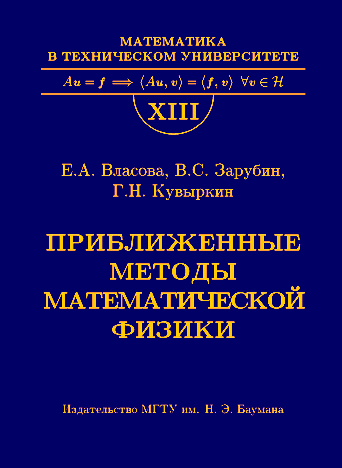
The thirteenth volume of the series “Mathematics at a Technical University”. It sets out mathematical models of physical processes, elements of applied functional analysis and approximate analytical methods for problems of mathematical physics, together with the finite difference, finite element and boundary element methods widely used in research and engineering, with examples of their use in applied problems.
The textbook follows the lecture courses the authors give at Bauman MSTU.
For students of technical universities; also useful for lecturers, postgraduates and engineers.
Contents
| Preface | ||
| Main notation | ||
| Part I. Mathematical models of physical processes | ||
| 1. | Basic physical substances | |
| 1.1. | Features of formulating problems of mathematical physics | |
| 1.2. | Density of physical substances | |
| 1.3. | Transport of physical substances | |
| A.1.1. | Some formulas of vector analysis | |
| Questions and problems | ||
| 2. | Conservation laws of physical substances | |
| 2.1. | Conservation of mass | |
| 2.2. | Divergence form of the continuity equation | |
| 2.3. | Conservation of electric charge and thermal energy | |
| 2.4. | Conservation of momentum | |
| A.2.1. | Vector analysis formulas for an inhomogeneous medium | |
| Questions and problems | ||
| 3. | Mathematical models of some media | |
| 3.1. | Models of an ideal fluid (gas) | |
| 3.2. | Models of a viscous fluid | |
| 3.3. | The elastic solid | |
| 3.4. | The energy transport equation in a medium | |
| 3.5. | Uravneniya Maksvella | |
| 3.6. | Electromagnetic processes in a slowly moving medium | |
| A.3.1. | Discontinuity surfaces in the electromagnetic field | |
| A.3.2. | Examples of problems described by integral equations | |
| Questions and problems | ||
| Part II. Elements of functional analysis | ||
| and approximate analytical methods | ||
| 4. | Operators in normed spaces | |
| 4.1. | Normed spaces | |
| 4.2. | Operators in normed spaces | |
| 4.3. | Linear operators | |
| 4.4. | Bounded linear functionals | |
| 4.5. | The normed space of linear operators | |
| 4.6. | Spectrum of a linear operator | |
| 4.7. | Completion of a normed space | |
| Questions and problems | ||
| 5. | Operators in Hilbert spaces | |
| 5.1. | Hilbert space | |
| 5.2. | Operators and functionals in Hilbert space | |
| 5.3. | The energy space | |
| 5.4. | The homogeneous operator equation | |
| 5.5. | Equations with completely continuous symmetric operators | |
| A.5.1. | Dual spaces and adjoint operators | |
| A.5.2. | A criterion for a system of functions to be a basis | |
| A.5.3. | Positive definiteness of an elliptic operator | |
| Questions and problems | ||
| 6. | Approximate analytical methods | |
| 6.1. | General scheme for constructing approximate methods | |
| 6.2. | Errors of approximate methods | |
| 6.3. | The small parameter method | |
| 6.4. | The general case of the small parameter method | |
| 6.5. | The method of orthogonal projections | |
| 6.6. | Subdomain and point collocation | |
| 6.7. | Least squares method | |
| 6.8. | The Bubnov–Galerkin and Ritz methods | |
| 6.9. | Eigenvalue problems | |
| 6.10. | Choosing basis functions | |
| A.6.1. | The projection method | |
| Questions and problems | ||
| Part III. Grid methods | ||
| 7. | Fundamentals of the finite difference method | |
| 7.1. | The notion of grid methods | |
| 7.2. | Approximating derivatives by finite differences | |
| 7.3. | The balance method | |
| 7.4. | An example of the simplest difference scheme | |
| Questions and problems | ||
| 8. | One-dimensional boundary value problems | |
| 8.1. | Difference schemes for steady problems | |
| 8.2. | The Sturm–Liouville problem | |
| 8.3. | The unsteady heat conduction problem | |
| 8.4. | Some dynamic problems | |
| A.8.1. | Modifications of the tridiagonal algorithm | |
| Questions and problems | ||
| 9. | Multidimensional problems | |
| 9.1. | Features of solving multidimensional problems | |
| 9.2. | Two- and three-dimensional heat conduction problems | |
| 9.3. | Various multidimensional problems | |
| A.9.1. | Matrix and orthogonal sweep algorithms | |
| Questions and problems | ||
| Part IV. Finite and boundary element methods | ||
| 10. Fundamentals of the finite element method | ||
| 10.1. | A one-dimensional boundary value problem | |
| 10.2. | Types of finite elements | |
| 10.3. | Matrix representation of functions | |
| Questions and problems | ||
| 11. Applied problems | ||
| 11.1. | Features of applying the finite element method | |
| 11.2. | Heat conduction problems in a solid | |
| 11.3. | Two-dimensional viscous flow | |
| 11.4. | Problems of elasticity theory | |
| 11.5. | Electromagnetic field in a cylindrical waveguide | |
| Questions and problems | ||
| 12. Introduction to the boundary element method | ||
| 12.1. | Boundary integral equations | |
| 12.2. | Ways of approximating functions on the boundary | |
| 12.3. | Accounting for anisotropy and inhomogeneity | |
| 12.4. | Unsteady problems | |
| 12.5. | The static problem of elasticity theory | |
| 12.6. | Comparison of boundary and finite element methods | |
| A.12.1. | Features of solving axisymmetric problems | |
| Questions and problems | ||
| Recommended reading | ||
| Subject index | ||