
Back to the list | Abstract | Contents
 Abstract
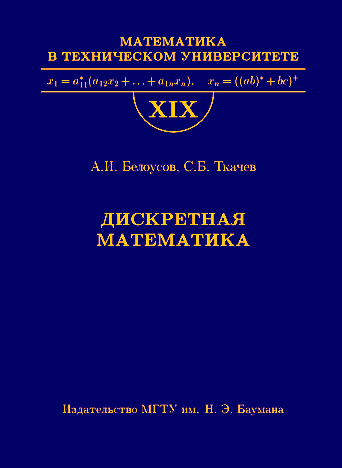
The nineteenth volume of the series “Mathematics at a Technical University” covers the theory of sets and relations, elements of modern abstract algebra, graph theory, the classical concepts of Boolean functions, and the foundations of formal language theory, including finite automata, regular languages, context-free languages and pushdown automata. Particular attention is paid to algebraic methods in the analysis of graphs and automata.
The textbook follows the lecture course the authors give at Bauman MSTU.
For students of technical universities; also useful for lecturers and postgraduates.
Contents
| Preface | ||
| Main notation | ||
| 1. | Sets and relations | |
| 1.1. | Sets | |
| 1.2. | Tuples. Cartesian product | |
| 1.3. | Correspondences and binary relations | |
| 1.4. | Operations on correspondences | |
| 1.5. | Families of sets | |
| 1.6. | Special properties of binary relations | |
| 1.7. | Equivalence relations | |
| 1.8. | Ordered sets | |
| 1.9. | Cardinality of a set | |
| Questions and problems | ||
| 2. | Algebras: groups and rings | |
| 2.1. | Operations. The notion of an algebraic structure | |
| 2.2. | Groupoids, semigroups, groups | |
| 2.3. | Rings, skew fields, fields | |
| 2.4. | Integral domains | |
| 2.5. | Modules and linear spaces | |
| 2.6. | Cyclic groups | |
| 2.7. | Subgroups and subrings | |
| 2.8. | Teorema Lagranzha | |
| 2.9. | Group homomorphisms and normal subgroups | |
| 2.10. | Ring homomorphisms | |
| Questions and problems | ||
| 3. | Semirings and Boolean algebras | |
| 3.1. | Semirings. Main examples | |
| 3.2. | Closed semirings | |
| 3.3. | Solving systems of linear equations in closed semirings | |
| 3.4. | Boolean algebras | |
| 3.5. | Lattices | |
| Questions and problems | ||
| 4. | Algebraic systems | |
| 4.1. | Predicates | |
| 4.2. | Algebraic systems: models and algebras | |
| 4.3. | Subsystems | |
| 4.4. | Congruences and quotient systems | |
| 4.5. | Homomorphisms | |
| 4.6. | Direct products of algebraic systems | |
| 4.7. | Many-sorted algebras | |
| Questions and problems | ||
| 5. | Graph theory | |
| 5.1. | Basic definitions | |
| 5.2. | Ways of representing graphs | |
| 5.3. | Trees | |
| 5.4. | Minimum spanning tree | |
| 5.5. | Graph traversal methods | |
| 5.6. | The path problem | |
| 5.7. | Graph isomorphism | |
| 5.8. | Computing the order function | |
| 5.9. | Elements of cyclomatic theory | |
| Questions and problems | ||
| 6. | Boolean functions | |
| 6.1. | The notion of a Boolean function. Truth tables | |
| 6.2. | Formulas and superpositions | |
| 6.3. | Disjunctive and conjunctive normal forms | |
| 6.4. | Constructing minimal DNFs | |
| 6.5. | Teorema Posta | |
| 6.6. | Circuits of functional elements | |
| Questions and problems | ||
| 7. | Finite automata and regular languages | |
| 7.1. | Alphabet, word, language | |
| 7.2. | Generative grammars | |
| 7.3. | Classification of grammars and languages | |
| 7.4. | Regular languages and regular expressions | |
| 7.5. | Finite automata. Kleene’s theorem | |
| 7.6. | Determinization of finite automata | |
| 7.7. | Minimization of finite automata | |
| 7.8. | The pumping lemma for regular languages | |
| Questions and problems | ||
| 8. | Context-free languages | |
| 8.1. | CF grammars. Derivation trees. Ambiguity. | |
| 8.2. | Reduced form of a CF grammar | |
| 8.3. | The pumping lemma for CF languages | |
| 8.4. | Pushdown automata | |
| 8.5. | Algebraic properties of CF languages | |
| Questions and problems | ||
| Recommended reading | ||
| Subject index | ||