
Back to the list | Abstract | Contents
 Abstract
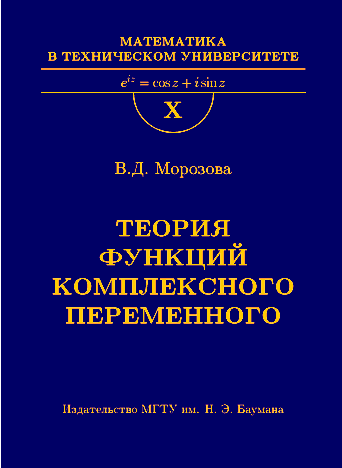
The tenth volume of the series “Mathematics at a Technical University” is devoted to the theory of functions of one complex variable, with attention to conformal mappings and applications of the theory to practical problems. It includes examples and problems from physics, mechanics and various branches of engineering.
The textbook follows the lecture course the author gives at Bauman MSTU.
For students of technical universities; also useful for lecturers and postgraduates.
Contents
| Preface | ||
| Main notation | ||
| 1. | The complex plane | |
| 1.1. | Algebraic form of a complex number | |
| 1.2. | Trigonometric form of a complex number | |
| 1.3. | The point at infinity. The Riemann sphere | |
| 1.4. | Geometry in the complex plane | |
| 1.5. | Defining sets of points in the complex plane | |
| Questions and problems | ||
| 2. | Sequences and series of complex numbers | |
| 2.1. | Sequences of complex numbers | |
| 2.2. | Complex number series | |
| 2.3. | Power series | |
| 2.4. | Disc of convergence | |
| 2.5. | Two-sided power series | |
| Questions and problems | ||
| 3. | Functions of a complex variable | |
| 3.1. | Definition and geometric representation of a function of a complex variable | |
| 3.2. | Limit and continuity of functions of a complex variable | |
| 3.3. | Elementary functions of a complex variable | |
| 3.4. | The multivalued function Arg z | |
| 3.5. | The logarithmic function | |
| 3.6. | Inverse trigonometric functions | |
| Questions and problems | ||
| 4. | Differentiation of functions of a complex variable | |
| 4.1. | Derivative of a function of a complex variable | |
| 4.2. | Necessary conditions for differentiability | |
| 4.3. | Sufficient conditions for differentiability | |
| 4.4. | Cauchy–Riemann conditions in polar coordinates | |
| 4.5. | Rules for differentiating functions of a complex variable | |
| 4.6. | Analytic functions | |
| 4.7. | Geometric meaning of the argument and modulus of the derivative | |
| 4.8. | The uniqueness theorem for analytic functions | |
| 4.9. | Reconstructing an analytic function | |
| from its real or imaginary part | ||
| 4.10. | The notion of analytic continuation | |
| Questions and problems | ||
| 5. | Integration of functions of a complex variable | |
| 5.1. | The integral of a function of a complex variable and its computation | |
| 5.2. | Cauchy’s integral theorems | |
| 5.3. | Path independence of the integral | |
| 5.4. | The Newton–Leibniz formula | |
| 5.5. | Cauchy’s integral formula | |
| 5.6. | Higher derivatives of an analytic function | |
| 5.7. | Sufficient conditions for analyticity | |
| A.5.1. | Complex potential of a plane vector field | |
| Questions and problems | ||
| 6. | Function series in the complex plane | |
| 6.1. | Uniform convergence of function series | |
| 6.2. | Properties of uniformly convergent series | |
| 6.3. | Ryad Teylora | |
| 6.4. | Taylor series expansion | |
| 6.5. | Ryad Lorana | |
| 6.6. | Finding all expansions of a function in given powers | |
| 6.7. | Connection between Laurent and Fourier series | |
| Questions and problems | ||
| 7. | Zeros and singular points of an analytic function | |
| 7.1. | Zeros of an analytic function | |
| 7.2. | Isolated singular points | |
| 7.3. | The point at infinity as a singular point | |
| 7.4. | Classification of analytic functions by their singular points | |
| A.7.1. | Physical interpretation of the poles of an analytic function | |
| Questions and problems | ||
| 8. | Residues at isolated singular points | |
| 8.1. | Residue at a finite point | |
| 8.2. | Computing the residue at a pole | |
| 8.3. | Residue at the point at infinity | |
| 8.4. | Using residues to compute integrals | |
| 8.5. | Logarithmic residue | |
| A.8.1. | Computing integrals of real functions | |
| Questions and problems | ||
| 9. | Geometric principles of complex analysis | |
| 9.1. | One-to-one mappings | |
| 9.2. | Properties of conformal mappings | |
| 9.3. | Teorema Rimana | |
| 9.4. | The boundary correspondence principle | |
| 9.5. | The maximum modulus principle | |
| 9.6. | The symmetry principle | |
| Questions and problems | ||
| 10. Conformal mappings | ||
| 10.1. | Linear mapping | |
| 10.2. | Linear fractional mapping | |
| 10.3. | The integer power function | |
| 10.4. | The exponential function | |
| 10.5. | Funktsiya Zhukovskogo | |
| 10.6. | Trigonometric and hyperbolic functions | |
| 10.7. | Single-valued branches of multivalued inverse functions | |
| A.10.1. | Mapping the half-plane onto the interior of a rectangle | |
| A.10.2. | The Schwarz–Christoffel integral | |
| Questions and problems | ||
| 11. Applied problems | ||
| 11.1. | Preliminary remarks | |
| 11.2. | Direct use of a known complex potential | |
| 11.3. | Flow around a cylindrical body | |
| 11.4. | Fluid flow in channels | |
| 11.5. | Problems from various areas of physics | |
| Recommended reading | ||
| Subject index | ||