Since 2012 · current head
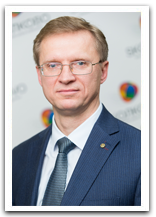
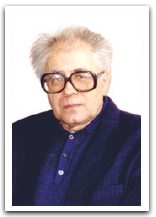
Vladimir Gladyshev
Head of the Fundamental Sciences research and education complex.
Doctor of Physical and Mathematical Sciences, Professor of Physics.
The Faculty of Fundamental Sciences at Bauman Moscow State Technical University.
Mathematics, mechanics, physics, chemistry and electrical engineering form the foundation of engineering education at Bauman Moscow State Technical University.
Faculty contactsFrom early teaching to research schools
Mathematics, physics and other natural sciences become part of teaching at Bauman.
The faculty is re-established at Bauman to provide fundamental training for future engineers.
The Fundamental Sciences research and education complex brings together the faculty and a research institute.
The faculty starts training engineers in Applied Mathematics.
The House of Physics opens with new teaching equipment, and electrical engineering facilities are renewed.
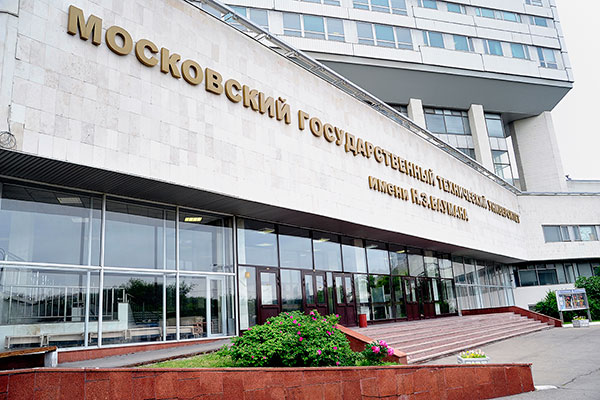 The departments of Physics and Mathematics establish the academic basis of the Faculty of Fundamental Sciences at Bauman Moscow State Technical University. The world-famous scientists worked there, such as Pafnuty Chebyshev, a mathematician and engineer; Nikolay Zhukovskiy, an engineer; Dmitriy Mendeleev, a scientist and encyclopedist; Sergey Chaplygin, a mathematician and engineer; Pyotr Lebedev, a physicist and experimentalist; Petr Lazarev, a physicist and biophysicist; Sergey Vavilov, a physicist, and many others.
The Faculty of Fundamental Sciences is currently the largest division of the University. It consists of the following departments: the Department of Theoretical Mechanics named after Professor Nikolay Zhukovskiy, four Departments of Mathematics, the Department of Physics, the Department of Chemistry, the Department of Electrical Engineering and Industrial Electronics.
The Faculty of Fundamental Sciences lays the educational foundation for future specialties of BMSTU graduates.
Nowadays, the Faculty of Fundamental Sciences opens new laboratories, does supercomputer calculations, conducts high-precision physical experiments, and develops international scientific projects.
· Physics
· Mathematical Simulation
Founded: 1997
Located: 2/18 Rubtsovskaya emb., 105005 Moscow.
Headed: A.P. Krishchenko
Professors (all ranks): 61
Students (majoring in math simulation): 95
The Department of Mathematical Simulation was established in 1997. It is a part of the Faculty of Fundamental Sciences, and it trains students from other faculties and departments such as Computer Science and Control Systems, Radio Electronics and Laser Technology, Biomedical Engineering, Radio Engineering, Laser and Optoelectronic Systems. The Department of Mathematical Simulation has been training students for their Bachelor and Master’s Degrees since 2015. The Head of the Department is Aleksandr Petrovich Krishchenko, a member of the Russian Academy of Sciences (RAS). His collected papers “Mathematics in Technical University” written in collaboration with other professors of the Department, was awarded by the Government of the Russian Federation in 2003.
The basic disciplines included in the Bachelor’s curriculum are Control Theory, Quality Theory of Differential Equations, Application Problems of Control Theory, Multidimensional Controllable Systems, Differential Geometry Methods of Control Theory and others. The advanced courses are related to Adaptive, Robust, Optimal Control Theories, Numerical Methods, Linear and Nonlinear Control Theory.
The Department of Mathematical Simulation trains highly-qualified specialists in nonlinear control theory of dynamic systems. Students do their practical training at the Faculty of Computational Mathematics and Cybernetics of Lomonosov Moscow State University, Trapeznikov Institute of Control Sciences of RAS and Federal Research Center of Computer Sciences and Control of RAS. The main researching projects are associated with probe movement, robotics, missiles, planes, helicopter dynamics.
The graduates of the Department are in demand in many organizations such as Scientific Research Institute of System Analysis, Central Research Institute of Machine Building (Russian rocket and spacecraft scientific center), Lavochkin Association, Russian Helicopters, Moscow Design Bureau Compass, Joint-Stock Company Radio Engineering Corporation “Vega”, Institutes of RAS and many IT companies, commercial projects and financial corporations.
The Department offers a post-graduate course for both Russian and foreign applicants. The research work is focused on System Analysis, Control and Information Processing and Mathematical Simulation, Numerical Methods and Software Packages.
From the faculty’s history
Head of the Fundamental Sciences research and education complex.
Doctor of Physical and Mathematical Sciences, Professor of Physics.
Head of the complex, Associate Professor of Theoretical Mechanics
Vice-Rector for the complex, Professor of Theoretical Mechanics
First Vice-Rector for the complex, Head of Applied Mathematics
Dean, Head of Electrical Engineering and Electronics
Dean, Professor of Engineering Graphics
First Dean, Professor of Machine Elements
Faculty structure