
Back to the list | Abstract | Contents
 Abstract
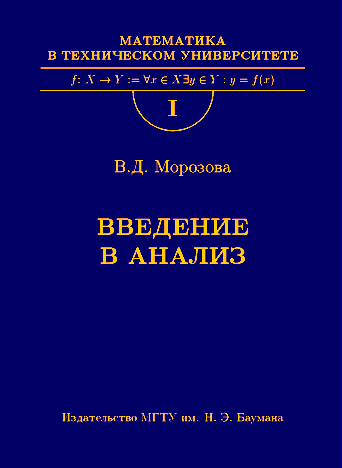
The first volume of the 20-volume series “Mathematics at a Technical University”. It introduces the concepts of function, limit and continuity, which are fundamental to mathematical analysis and essential at the start of a technical university course.
It shows the close connection of classical analysis with modern mathematics, above all set theory and continuous mappings of metric spaces.
The textbook follows the lecture course the author gives at Bauman MSTU.
For students of technical universities; also useful for lecturers and postgraduates.
Contents
| To the reader | ||
| Preface | ||
| A brief historical sketch | ||
| 1. | Elements of set theory | |
| 1.1. | Sets | |
| 1.2. | Subsets | |
| 1.3. | The set of real numbers. The number line | |
| 1.4. | Operations on sets | |
| 1.5. | Some basic logical symbols | |
| 1.6. | Krugi Eylera | |
| Questions and problems | ||
| 2. | Mappings of sets. Functions | |
| 2.1. | The notions of mapping and function | |
| 2.2. | Surjection, injection and bijection | |
| 2.3. | The inverse mapping | |
| 2.4. | Composition of mappings | |
| 2.5. | Product of sets. Graph of a mapping | |
| 2.6. | Ordered sets. Elements of combinatorics | |
| 2.7. | Bounded sets | |
| A.2.1. | Cardinality of a set | |
| A.2.2. | Fixed point of a mapping | |
| Questions and problems | ||
| 3. | Real functions of a real variable | |
| 3.1. | A function and its graph | |
| 3.2. | Main ways of defining a function | |
| 3.3. | Composite and mutually inverse functions | |
| 3.4. | Some properties of functions | |
| 3.5. | Basic elementary functions | |
| 3.6. | Some elementary functions | |
| Questions and problems | ||
| 4. | Laws of composition and algebraic structures | |
| 4.1. | Laws of composition | |
| 4.2. | Main algebraic structures | |
| 4.3. | The field of complex numbers | |
| 4.4. | The polynomial ring | |
| 4.5. | The permutation group | |
| Questions and problems | ||
| 5. | Continuous mappings of metric spaces | |
| 5.1. | The notion of a metric space | |
| 5.2. | Neighbourhoods in a metric space | |
| 5.3. | Characteristic points of sets | |
| 5.4. | Closed sets | |
| 5.5. | Compact sets | |
| 5.6. | Definition of a continuous mapping | |
| 5.7. | Properties of continuous mappings of sets | |
| 5.8. | Path-connected sets | |
| 5.9. | Uniform continuity | |
| Questions and problems | ||
| 6. | Number sequences | |
| 6.1. | Variable quantities | |
| 6.2. | The notion of a number sequence | |
| 6.3. | Limit of a sequence | |
| 6.4. | Properties of convergent sequences | |
| 6.5. | Tests for the existence of the limit of a sequence | |
| 6.6. | The number e | |
| 6.7. | Infinitesimal and infinitely large sequences | |
| A.6.1. | Limit points of a sequence | |
| A.6.2. | Proof of the Weierstrass test and the Cauchy criterion | |
| Questions and problems | ||
| 7. | Limit of a function at a point | |
| 7.1. | Definition of the limit of a function | |
| 7.2. | One-sided limits | |
| 7.3. | Tests for the existence of a limit | |
| 7.4. | Properties of functions with a finite limit | |
| 7.5. | Infinitesimal and infinitely large functions | |
| 7.6. | Limit of a composite function | |
| 7.7. | Two remarkable limits | |
| 7.8. | The exponential, natural logarithms and hyperbolic functions | |
| Questions and problems | ||
| 8. | Theory of limits | |
| 8.1. | The notion of the limit of a mapping | |
| 8.2. | Some properties of the limit of a mapping | |
| 8.3. | Limits of real functions | |
| 8.4. | Tests for the existence of the limit of a real function | |
| A.8.1. | Complete metric spaces | |
| A.8.2. | The contraction mapping principle | |
| Questions and problems | ||
| 9. | Continuous functions | |
| 9.1. | Continuity of a function at a point | |
| 9.2. | Properties of functions continuous at a point | |
| 9.3. | One-sided continuity. Points of discontinuity | |
| 9.4. | Properties of functions continuous on an interval | |
| 9.5. | Continuity of the basic elementary functions | |
| 9.6. | Finding a zero of a function continuous on a segment | |
| A.9.1. | Continuity and discontinuities of a monotonic function | |
| A.9.2. | Proofs of theorems on functions continuous on an interval | |
| Questions and problems | ||
| 10. Asymptotic behaviour | ||
| 10.1. | Comparing infinitesimal functions | |
| 10.2. | Equivalent infinitesimal functions | |
| 10.3. | The principal part of an infinitesimal function | |
| 10.4. | Comparing infinitely large functions | |
| 10.5. | Oblique asymptote of the graph of a function | |
| 10.6. | General recommendations for computing limits | |
| A.10.1. | Asymptotic polynomials | |
| A.10.2. | Using the symbols O and o | |
| Questions and problems | ||
| Recommended reading | ||
| Subject index | ||