
Back to the list | Abstract | Contents
 Abstract
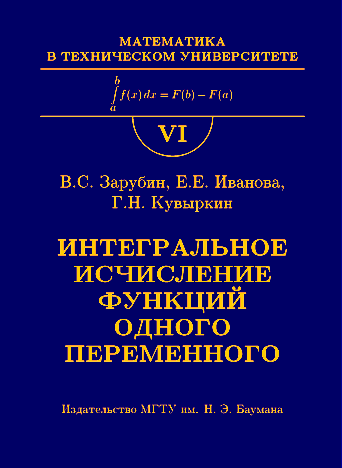
The sixth volume of the series “Mathematics at a Technical University” introduces indefinite and definite integrals and methods for computing them, with attention to applications of the definite integral and examples from physics, mechanics and engineering.
The textbook follows the lecture course the author gives at Bauman MSTU.
For students of technical universities; also useful for lecturers and postgraduates.
Contents
| Preface | ||
| Main notation | ||
| 1. | The indefinite integral | |
| 1.1. | Introductory remarks | |
| 1.2. | Antiderivative and indefinite integral | |
| 1.3. | Properties of the indefinite integral | |
| 1.4. | Basic indefinite integrals | |
| 1.5. | Integration by substitution and change of variable | |
| 1.6. | Integration by parts | |
| A.1.1. | Antiderivative of a continuous function | |
| Questions and problems | ||
| 2. | Integrating rational fractions | |
| 2.1. | Rational integrands | |
| 2.2. | Integrals of simple rational fractions | |
| 2.3. | Partial fraction decomposition of a proper rational fraction | |
| 2.4. | Integrating rational functions | |
| A.2.1. | Metod Ostrogradskogo | |
| A.2.2. | Integrating rational functions containing binomials | |
| Questions and problems | ||
| 3. | Integrating irrational expressions | |
| 3.1. | Rational functions of radicals | |
| 3.2. | Integrating functions with radicals of a linear fractional function | |
| 3.3. | Podstanovki Eylera | |
| 3.4. | Other integration techniques | |
| 3.5. | Trigonometric and hyperbolic substitutions | |
| 3.6. | Integrals of a differential binomial | |
| A.3.1. | Geometric meaning of Euler substitutions | |
| A.3.2. | Integrating functions of the form  |
|
| Questions and problems | ||
| 4. | Integrals of some transcendental functions | |
| 4.1. | Rational functions of sine and cosine | |
| 4.2. | Rational powers of sine and cosine | |
| 4.3. | Exponential and hyperbolic functions | |
| 4.4. | Various transcendental expressions | |
| Questions and problems | ||
| 5. | Integral Nyutona | |
| 5.1. | The Newton definite integral | |
| 5.2. | The Newton–Leibniz formula | |
| 5.3. | Properties of the Newton integral | |
| 5.4. | The mean value theorem and its consequences | |
| 5.5. | The Newton integral with variable limits | |
| 5.6. | Geometric and mechanical interpretation of the Newton integral | |
| 5.7. | Ways of computing the Newton integral | |
| Questions and problems | ||
| 6. | The definite integral | |
| 6.1. | The integral sum and its limit | |
| 6.2. | Integral Rimana | |
| 6.3. | Darboux sums and integrals | |
| 6.4. | A criterion for the existence of the definite integral | |
| 6.5. | Classes of integrable functions | |
| 6.6. | Properties of integrable functions | |
| 6.7. | Main properties of the definite integral | |
| 6.8. | Mean value theorems for the definite integral | |
| 6.9. | The definite integral with a variable limit | |
| 6.10. | Computing the definite integral | |
| A.6.1. | Proofs of theorems on classes of integrable functions | |
| A.6.2. | Proof of Theorems 6.19 and 6.20 | |
| A.6.3. | Connection between the Newton and Riemann integrals | |
| A.6.4. | Generalized mean value theorems | |
| Questions and problems | ||
| 7. | Improper integrals | |
| 7.1. | Integrals over an infinite interval | |
| 7.2. | Main properties of convergent improper integrals over an infinite interval | |
| 7.3. | Convergence tests for integrals over an infinite interval | |
| 7.4. | Integrals of unbounded functions | |
| 7.5. | Convergence of integrals of unbounded functions | |
| 7.6. | Absolute and conditional convergence of improper integrals | |
| 7.7. | Other convergence tests for improper integrals | |
| 7.8. | Examples of testing improper integrals for convergence | |
| 7.9. | Transforming improper integrals | |
| 7.10. | Principal values of improper integrals | |
| Questions and problems | ||
| 8. | Integrals depending on a parameter | |
| 8.1. | Definite integrals depending on a parameter | |
| 8.2. | Differentiating integrals with respect to a parameter | |
| 8.3. | Integration with respect to a parameter | |
| 8.4. | Uniform convergence of improper integrals | |
| 8.5. | Tests for uniform convergence of improper integrals | |
| 8.6. | Continuity and differentiability of improper integrals with respect to a parameter | |
| 8.7. | Integrating improper integrals with respect to a parameter | |
| 8.8. | Euler integrals | |
| Questions and problems | ||
| 9. | Applications of the definite integral | |
| 9.1. | General scheme for applying the integral | |
| 9.2. | Arc length | |
| 9.3. | Area of a plane figure | |
| 9.4. | Volume of a solid | |
| 9.5. | Surface area | |
| 9.6. | Computing masses and moments of inertia | |
| 9.7. | Static moments and centre of mass | |
| 9.8. | Work, energy, pressure force | |
| A.9.1. | Motion of a material point in a central gravitational field | |
| Questions and problems | ||
| 10. Numerical integration | ||
| 10.1. | The essence of numerical integration | |
| 10.2. | The trapezoidal rule | |
| 10.3. | Simpson’s rule | |
| 10.4. | Rectangle rules | |
| 10.5. | Approximation by higher-degree polynomials | |
| 10.6. | Gaussian quadrature | |
| 10.7. | Practical error estimation in numerical integration | |
| 10.8. | Accounting for features of the integrand | |
| 10.9. | Approximate computation of improper integrals | |
| 10.10. | Features of computing indefinite integrals | |
| Questions and problems | ||
| Appendix. Table of indefinite integrals | ||
| Recommended reading | ||
| Subject index | ||